


Communiqués
Le comité citoyen responsable de l’examen des quartiers électoraux et des modes de représentation à Edmundston soumet son rapport
15 avr. 2025
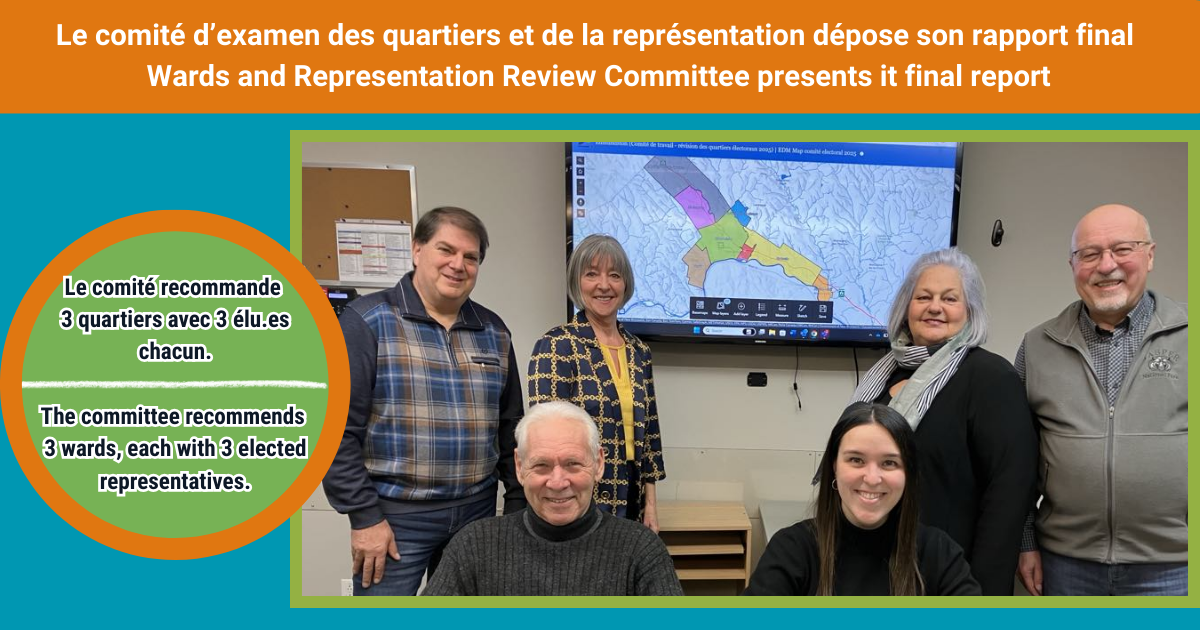
Après une période intense de consultation publique, avec des sessions publiques, un sondage en ligne et des rencontres avec divers experts, le comité citoyen responsable de l’examen des quartiers électoraux et des modes de représentation a présenté son rapport final au conseil municipal dans le cadre de la réunion publique mensuelle.
En plus de recueillir et d’analyser les commentaires de la population, le comité d’examen a procédé à la tâche complexe d’analyser les données et des meilleures pratiques. La recommandation formelle du comité est de diviser le nouveau territoire municipal en trois quartiers électoraux, représentés par trois conseillers, conseillères chacun. Le rapport complet peut être consulté et téléchargé en CLIQUANT ICI.
Selon le président du comité, le juge à la retraite M. George Pérusse, cette nouvelle façon de faire est dynamique, avant-gardiste et progressiste. « Nous sommes d’avis qu’elle représente un modèle effectif et équitable, collaboratif, et encourage un partenariat avec les communautés rurales et urbaines. Elle insuffle un sens de confiance, de fierté et d’appartenance sur l’ensemble du nouveau territoire », a-t-il expliqué aux membres du conseil municipal.
Le comité a examiné divers modèles de représentation, les nombre de quartiers et le nombre idéal de conseillers et conseillères pour en arriver à sa recommandation. Le modèle recommandé de 3 quartiers se découpe géographiquement sur les trois axes principaux de la municipalité et combine les quartiers 2 et 5, les quartiers 4 et 3. Le quartier 1 demeure dans son intégralité.
« En proposant ce changement, nous arrivons près de la parité du nombre d’électeurs et d’électrices par quartier, tel que précisé par la jurisprudence, c’est-à-dire que le Quartier 1 se retrouve avec 4808 électeurs et électrices; le Quartier 2 avec 4192 électeurs et électrices, et le Quartier 3 avec 5160 électeurs électrices. Il y a également un équilibre géographique et une équité du pouvoir entre les quartiers, » a expliqué M. Pérusse.
Notons que le comité a tenu des sessions de consultation publique dans chaque quartier du 10 au 25 février. Du 25 février au 7 mars, le comité a mis à la disponibilité des citoyennes et des citoyens un sondage en ligne afin de connaitre le point de vue de la population sur les différents modèles à l’étude. Au total, 77 personnes ont participé aux rencontres dans les quartiers et 145 personnes ont répondu au sondage. Le comité a également consulté des experts et effectué une révision de la documentation pertinente au niveau des municipalités canadiennes.
Le conseil municipal prend le rapport final en délibéré et devrait procéder avec une modification à l’arrêté municipal d’ici la fin de l’été. L’arrêté doit par la suite être approuvé par le gouvernement provincial à l’automne et mis en place pour les élections municipales de 2026.
Notons en terminant que le comité d’examen était composé de M. George Pérusse, Mad. Noëlline LeBel, M. Bernard LeBel, Mad. Madeleine Dubé, M. Jacques Desjardins et Mad. Dominique Babineau.
-30-
CONTACT : M. George Pérusse, revision.zones@gmail.com