


Communiqués
Lutte préventive contre les chenilles de la livrée des forêts : vous pouvez faire votre part!
24 avr. 2025
L’été arrivera très bientôt et les arbres redeviendront pleins de feuilles. Avant la pousse des feuilles dans les arbres, c’est le moment parfait pour inspecter vos petits arbres et arbustes autour de la maison et éliminer les œufs de la livrée des forêts. Depuis les deux dernières années, les chenilles de la livrée des forêts (Malacosoma disstria) ont envahi plusieurs arbres feuillus dans notre communauté, causant d’importants dommages au feuillage et plusieurs désagréments pour les citoyens et citoyennes.
Les arbres ont des réserves et peuvent avoir une nouvelle pousse de feuilles au courant de l’été. Cependant, si un arbre est défolié à maintes reprises pendant quelques années, il pourrait subir des conséquences irréversibles et finir par mourir. La bonne nouvelle : il est possible d’agir préventivement, dès maintenant, pour limiter leur apparition de la livrée des forêts chez vous. En ce début de saison, voici quelques conseils afin d’intervenir facilement et efficacement :
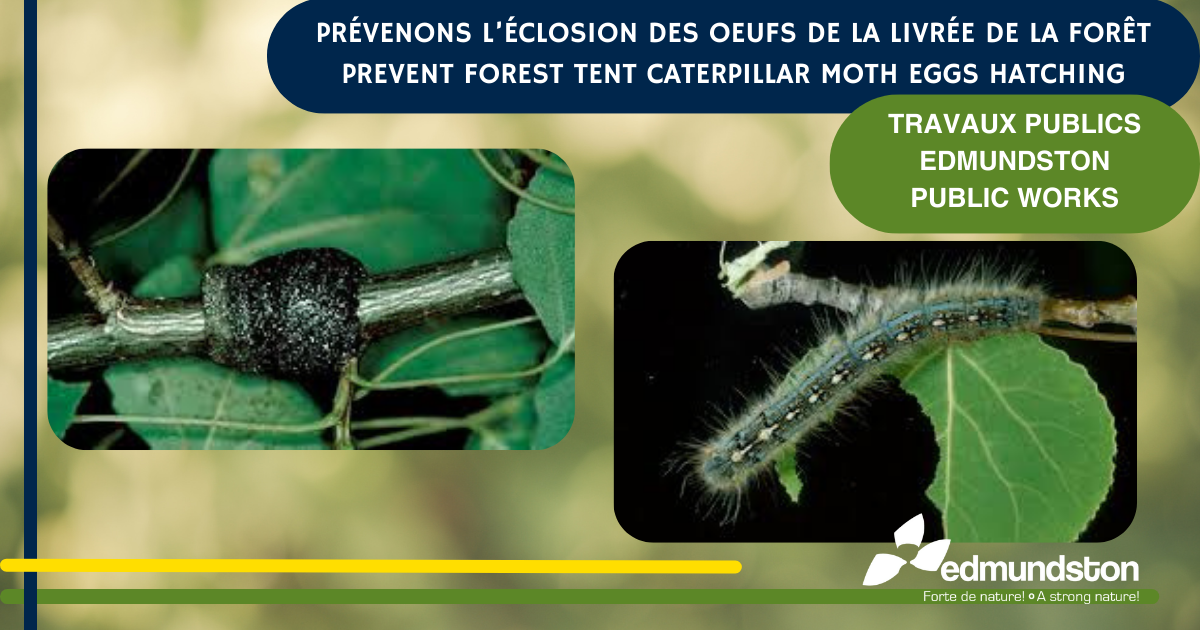
Comment repérer les œufs ?
- Ils se présentent sous forme de petits manchons brun-gris, collés autour des jeunes rameaux
- On les trouve surtout sur des arbres comme les peupliers, bouleaux, cerisiers, pommiers, érables, etc.
- Ces œufs ont été pondus à la fin de l’été dernier et ont passé l’hiver ainsi, prêts à éclore dès le printemps
Comment les enlever ?
- Portez des gants, même si les œufs ne sont pas urticants
- Inspectez vos arbres, en particulier les branches à votre hauteur
- Grattez ou taillez les rameaux portant les œufs à l’aide d’un outil (couteau, sécateur)
- Placez les œufs dans un sac de plastique fermé et jetez-le à la poubelle
- Évitez de laisser les œufs au sol, car les chenilles pourraient tout de même éclore
En retirant les œufs...
- Vous protégez vos arbres contre une défoliation prématurée
- Vous réduisez la propagation dans votre voisinage
- Vous limitez les nuisances causées par les chenilles urticantes plus tard en saison
Veuillez noter que même si chacun fait sa part pour enlever les œufs, il sera fort probable que des chenilles de la livrée des forêts apparaîtront dans certains secteurs de la municipalité. Il faut se rappeler que c’est une espèce indigène qui représente un problème d’esthétique temporaire. De façon générale, ce n’est pas un problème pour l’environnement, les arbres vont repousser des feuilles et les chenilles finiront par disparaitre.
Un geste simple, écologique et efficace pour préserver la santé de nos arbres!
Merci de votre collaboration!
-30-
CONTACT : Daniel Gautreau, Coordonnateur aux espaces verts, Service des travaux publics, 506.739-2103, daniel.gautreau@edmundston.ca